What a 5×5 storage unit actually holds.
Twenty-five square feet is small enough that the size decision is arithmetic, not opinion. Click items into the floorplan below and watch the floor run out. We size the unit against real item dimensions and we do not publish a rate table we cannot stand behind. No lead form, no affiliate revenue.
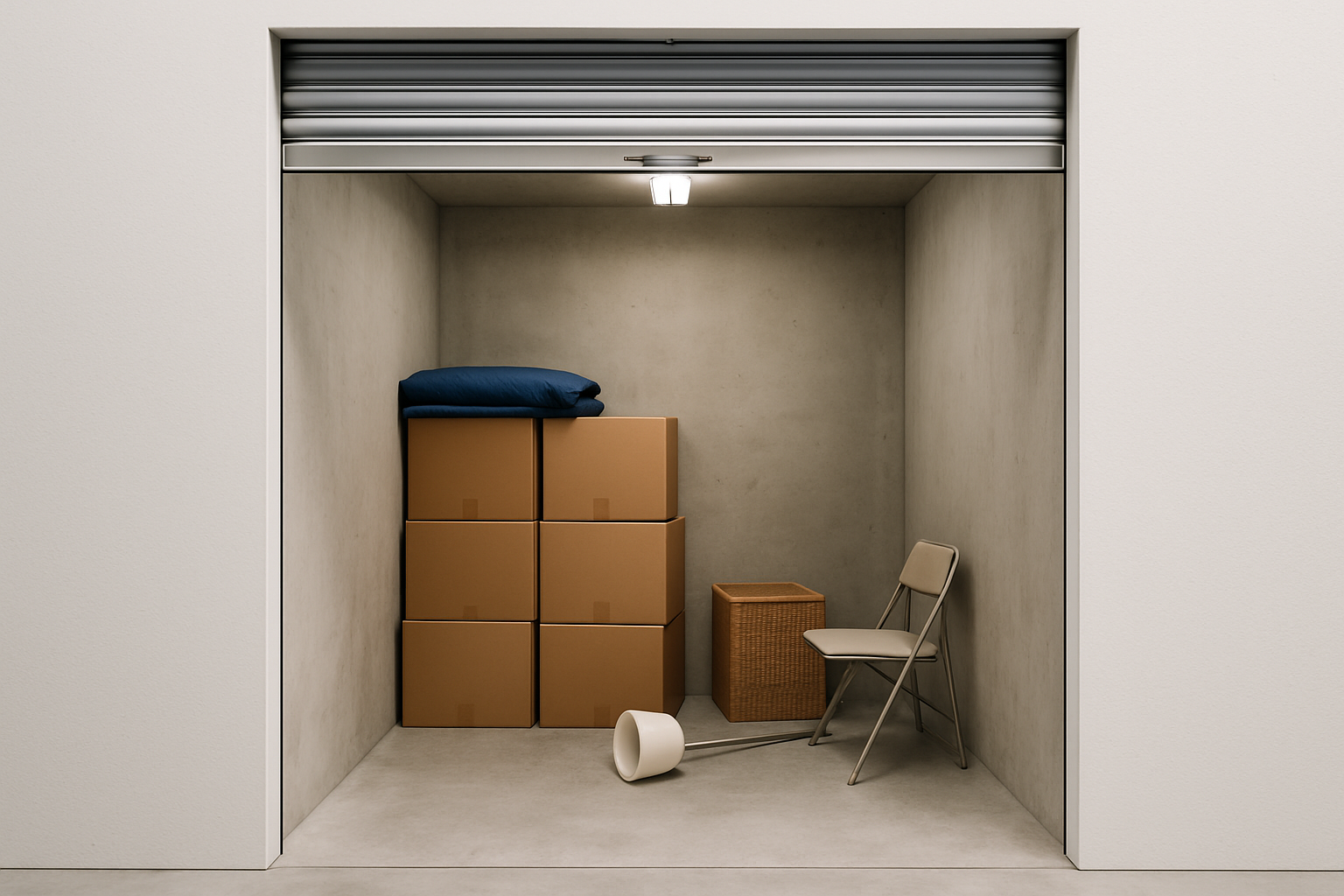
A 5×5 is 60 in by 60 in: 1.52 m by 1.52 m, 2.32 m² of floor.
The size is quoted in feet and sold in feet, so every other unit below is a conversion of 5 ft by 5 ft at 1 in = 25.4 mm, taken with the 8 ft ceiling that is standard across the industry. The diagonal matters more than the area: it is the longest straight line the floor will take, and it is what rules a motorcycle out.
| Measure | Imperial | Metric |
|---|---|---|
| Floor, each side | 5 ft (60 in) | 1.52 m |
| Floor area | 25 sq ft | 2.32 m² |
| Ceiling height | 8 ft | 2.44 m |
| Volume | 200 cu ft | 5.66 m³ |
| Floor diagonal | 7 ft 1 in | 2.16 m |
Arithmetic, not a survey. Volume assumes the unit is empty to the ceiling, which no usable unit is. Compare every small size side by side.
What fits in 25 square feet.
We can tell you which way prices are moving. Not what you will pay.
No free public source publishes what a 5×5 costs by city, and the operator listing pages that carry live rates are not ours to copy. What does exist is the US Bureau of Labor Statistics producer price index for miniwarehouse and self-storage unit operators. In September 2026 it stood at 186.8, on an index where December 2003 equals 100: -0.3% versus a year earlier and still 6.9% below the December 2023 peak.
| Year | Index (avg) | Change |
|---|---|---|
| 2019 | 149.8 | n/a |
| 2020 | 146.9 | -1.9% |
| 2021 | 159.0 | +8.2% |
| 2022 | 184.6 | +16.1% |
| 2023 | 197.0 | +6.7% |
| 2024 | 191.1 | -3.0% |
| 2025 | 185.4 | -3.0% |
Calendar-year averages of the monthly index. Source: US Bureau of Labor Statistics, series PCU531130531130, retrieved via St. Louis Fed (FRED) on 2026-10-15. Full read-out and caveats →
What goes in, and the one thing that does not.
Every judgement is an item dimension set against the 5 ft by 5 ft floor and the 8 ft ceiling. Motorcycles do not fit; most small-household items do. Searching a 4×5 storage unit? That is a locker size, often 4 ft tall. See how every small size (2×5, 4×5, 10×5, 15×5) compares.
This site used to publish an 18-metro table of 5×5 rates, plus a national figure triangulated in part from a subscription industry rate product. The metro table was built by fetching one operator's own city listing pages, which their terms do not permit.
We withdrew both rather than re-estimating them. There is no modelled replacement, because a model dressed as a measurement is worse than an honest gap. The methodology page sets out exactly what went and why.
5×5 storage, answered.
How big is a 5x5 storage unit?
A 5x5 unit has a 5 ft by 5 ft floor, 25 square feet, and about 200 cubic feet at the 8 ft ceiling that is standard across the industry. It is the smallest standard unit operators rent as a walk-in size.
What are the dimensions of a 5x5 storage unit in metres?
1.52 m by 1.52 m, which is 2.32 square metres of floor. At the 8 ft (2.44 m) ceiling the volume is 5.66 cubic metres. The floor diagonal, which is what decides whether a long item goes in at an angle, is 2.16 m. These are exact conversions of 60 in by 60 in at 1 in = 25.4 mm, not rounded trade figures.
What does a 5x5 storage unit look like?
A bare concrete square with a roll-up or swing door on one 5 ft wall, block or corrugated-panel walls, a light overhead, and nothing else. There is no shelving unless you bring it. The photograph at the top of this page shows a typical one loaded to about half capacity, and the interactive floorplan below it is drawn to scale, so you can drop real items in and watch the 25 square feet run out. What surprises most people on first viewing is the height: at 8 ft the unit is taller than it is wide, and the volume you are paying for is mostly above head height.
Is a 5x5 a storage unit or a storage locker?
A unit. The 5x5 is the smallest walk-in size the major operators rent, so you open a door and step inside it. A locker is smaller than that and not a distinct size at every facility: the sizes people search for below 5x5, such as 2x5, 3x5 and 4x5, are not rented as walk-in units at any major operator, and where a facility offers anything in that range it is a locker rather than a unit. If a listing calls a 25 square foot space a locker, it is using the word loosely.
Is there a 5x5 storage unit near me?
Almost certainly, because the 5x5 is the smallest unit the major operators rent as a distinct walk-in size, so most facilities that rent walk-in units stock it. What varies between two facilities in the same town is not the 25 square feet, it is climate control, whether the unit is ground floor or up a lift, gate hours, and the rate that applies from month two. Compare those four things across two or three sites before you compare the headline rate.
What fits in a 5x5 storage unit?
Realistically: five to eight moving boxes alongside a chair or nightstand, plus seasonal items, suitcases and a lamp. Stacked with nothing else in the unit you can get 15 to 25 boxes in, but you will not be able to reach the bottom layer. A queen mattress goes in on its edge and takes a whole wall. A motorcycle does not fit at any angle, because a road bike is longer than the 7 ft 1 in diagonal of the floor.
How much does a 5x5 storage unit cost?
We do not publish a figure, because no free public source supports one. Operator listing pages carry live rates but are not ours to copy, and industry rate datasets are subscription products. What we can report is direction: the US Bureau of Labor Statistics producer price index for self-storage operators stood at 186.8 in September 2026, essentially flat on a year earlier (down 0.3%) and 6.9% below its December 2023 peak. For a number that applies to you, get two or three local quotes for the same week and ask each what the rate becomes in month two.
Why is the price quoted online lower than what I actually pay?
Operators commonly advertise an introductory rate for the first month or the first few months, and apply a different standing rate afterwards. Separately, rates on an existing tenancy get reviewed, and the first review often lands within the first six months. Ask for the month-two rate in writing before you sign, and diary the review date.